Tragedy in Kwara: Nearly 200 Killed in Devastating Jihadist Attack on Communities Refusing Conversion By Ibrahim Adeyemi, AfriVerse Security Correspondent | February 8, 2026
ILORIN, Nigeria — In what security analysts are calling one of the most horrific attacks on Nigerian soil in recent memory, armed jihadist militants have killed nearly 200 civilians in coordinated assaults on multiple communities in Kwara State, targeting villages that refused to convert to their extremist ideology.
The attacks, which occurred over a 48-hour period between February 5-7, 2026, have left the nation in shock and prompted emergency security meetings at the highest levels of government. Eyewitnesses describe scenes of unimaginable horror as heavily armed militants swept through rural communities in the early hours of the morning.
The Attack Unfolds According to survivors who spoke exclusively to AfriVerse, the attackers arrived in convoys of motorcycles and pickup trucks mounted with heavy weapons. They systematically moved from village to village, issuing ultimatums to residents: convert or face death. "They came at around 3 AM when everyone was asleep," recounted Mama Aduke, a 60-year-old grandmother who lost three sons in the attack.
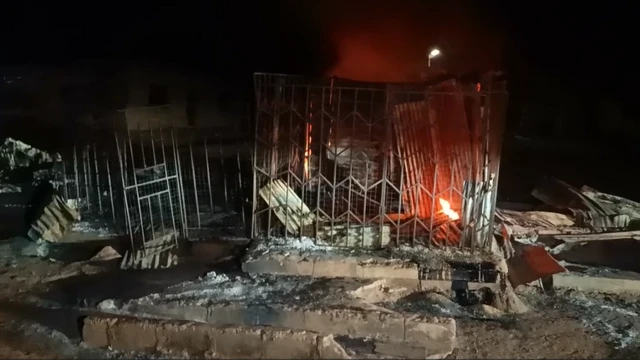
"They gathered all the men in the village square and asked them to renounce their faith. When they refused, they opened fire without mercy." The Nigerian Police Force confirmed the death toll in a statement released late Friday evening. "We can confirm that approximately 189 bodies have been recovered from the affected communities," said Force Public Relations Officer, ACP Muyiwa Adejobi.
"Search and rescue operations are ongoing, and we fear the number may rise." The attacks targeted at least seven communities in the Baruten and Kaiama Local Government Areas of Kwara State, near the border with Benin Republic. The affected villages include: - Gwanara - Yashikira - Okuta - Ilesha-Baruba - Kaiama Central - Bani - Kemanji These communities, predominantly comprised of Baruba and Boko ethnic groups, have historically resisted extremist influence, maintaining their traditional religious practices alongside Christianity and moderate Islam.
President Bola Ahmed Tinubu, who was attending an African Union summit in Addis Ababa when the attacks occurred, cut short his trip and returned to Abuja to convene an emergency National Security Council meeting. "This barbaric act will not go unpunished," President Tinubu declared in a nationally televised address. "We will hunt down every perpetrator and bring them to justice. The Federal Government is deploying additional military assets to Kwara State immediately."
The President announced a N5 billion emergency relief fund for affected communities and ordered the immediate deployment of two additional Army battalions to the region. The Nigerian Army has launched "Operation Sahel Sanity II" in response to the massacre. Major General Ibrahim Musa, Commander of the 32 Artillery Brigade, confirmed that air and ground operations have commenced.
"We have identified several militant camps in the forests bordering Kwara and Niger States," General Musa told journalists at a briefing in Ilorin. "Airstrikes have been conducted, and ground troops are advancing. We will not rest until these terrorists are eliminated." The Air Force confirmed conducting precision strikes on suspected militant hideouts, destroying several structures and eliminating an unspecified number of fighters.
Security experts warn that the attack represents a troubling southward expansion of jihadist activity, which has traditionally been concentrated in Nigeria's northeastern states. "This is a watershed moment for Nigeria's security landscape," said Dr. Olayinka Ajala, Security Analyst at Leeds Beckett University and consultant to the African Union. "The fact that these groups can operate with such impunity this far south suggests a significant failure of intelligence and border security."
The proximity to the Benin Republic border has raised concerns about cross-border militant movements. Benin's President Patrice Talon has offered to cooperate with Nigerian authorities in securing the border region. The international community has responded with unified condemnation. United Nations Secretary-General António Guterres called the attacks "a crime against humanity" and offered UN support for humanitarian relief efforts. The African Union, European Union, and United States have all issued statements condemning the violence.
US Secretary of State issued a statement expressing "deep concern" and offering intelligence and logistical support to Nigerian security forces. "The United States stands with Nigeria in this dark hour," the statement read. "We are prepared to provide any assistance necessary to bring the perpetrators to justice and prevent future atrocities." The attacks have triggered a massive displacement crisis, with an estimated 15,000 people fleeing affected communities. The Nigerian Red Cross Society has established emergency camps in Ilorin and Kaiama town.
"We are overwhelmed," admitted Red Cross State Director, Mrs. Folashade Akinola. "We need tents, food, medicine, and trauma counselors. Many survivors are in severe psychological distress." The National Emergency Management Agency (NEMA) has deployed personnel and supplies to the region, but aid workers say the response is insufficient given the scale of the disaster. As the nation mourns, difficult questions are being asked about how such a large-scale attack could occur without prior intelligence warning.
Opposition politicians have called for the resignation of the National Security Adviser and the Inspector General of Police. "This is a monumental failure of our security apparatus," said Senator Dino Melaye, Chairman of the Senate Committee on Security. "How did hundreds of armed militants move across state lines undetected? Heads must roll." The Kwara State Government has declared seven days of mourning.
Governor AbdulRazaq ordered flags to fly at half-mast across all government buildings. In Gwanara, the worst-hit community, survivors are still searching for missing relatives. The local mosque and church, which stood side by side for decades as symbols of religious harmony, were both destroyed in the attack. "They wanted to divide us by religion," said Pastor Emmanuel Adebayo, whose church was burned with congregants inside. "But they have only united us in grief. We will rebuild together."
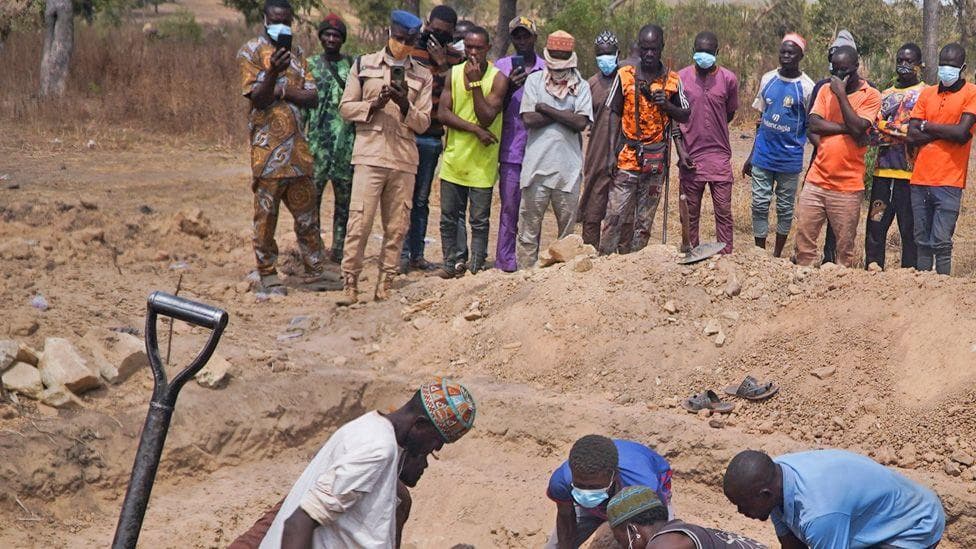
As mass burials begin this weekend, the people of Kwara face the unimaginable task of laying nearly 200 souls to rest—fathers, mothers, children, and elders whose only crime was refusing to abandon their beliefs. For Nigeria, the massacre serves as a grim reminder that the battle against extremism is far from over, and that vigilance must extend far beyond the traditionally troubled northeast.